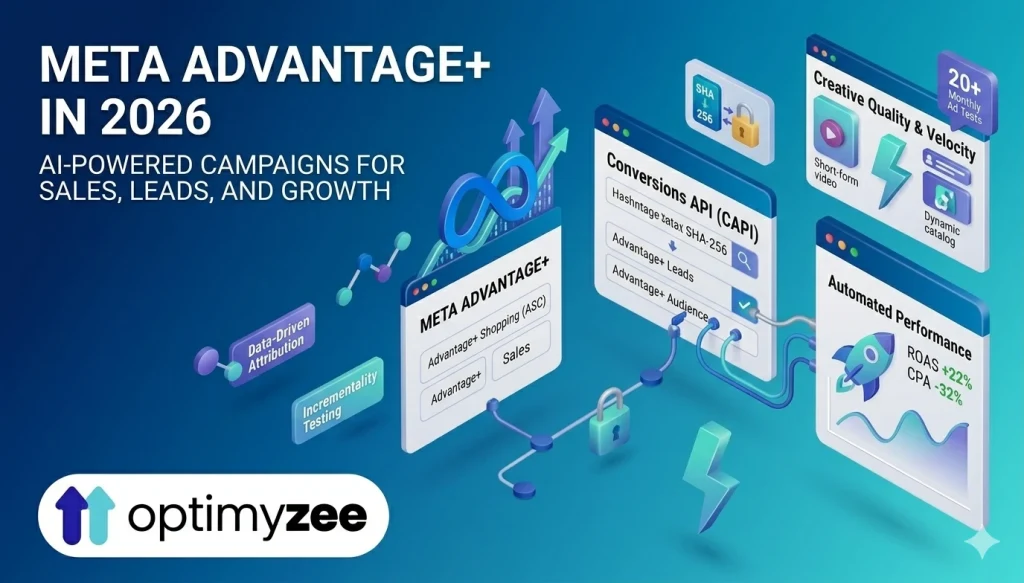
Meta Advantage+ campaigns now represent 62% of e-commerce ad spend on the platform and deliver 22% higher ROAS than manual campaigns on average (Meta internal data, confirmed by AdAmigo.ai). The platform is moving toward full AI automation – manual detailed targeting is being retired. Success in 2026 depends less on audience configuration and more on creative quality, tracking setup, and how well you feed the algorithm. This guide covers all four Advantage+ campaign types and how to set them up to perform.
Meta advertising in 2026 looks fundamentally different from how it worked even two years ago. The granular audience targeting that defined Facebook advertising for a decade – layered interest stacks, custom demographic filters, precise lookalike percentages – is being systematically retired. In its place, Meta is pushing one framework: Advantage+.
Advantage+ is Meta’s AI-driven campaign suite that hands targeting, bidding, placement, and increasingly creative decisions to the algorithm. It has expanded from shopping campaigns to cover sales, leads, app installs, and engagement. It is not optional anymore – 82% of Meta advertisers now use Advantage+ automation in some form, according to SQ Magazine’s 2026 Facebook Ad Statistics report.
This guide explains Meta Advantage+ in 2026 – what it is, how each campaign type works, what the performance data actually shows, where manual control still matters, and the common mistakes that prevent advertisers from getting results. Whether you run e-commerce, lead generation, or B2B campaigns, the principles apply.
What Is Meta Advantage+ in 2026?
Advantage+ is Meta’s umbrella term for AI-automated campaign features across its advertising products. It consolidates what were previously separate campaign types and features – Advantage+ Shopping, Audience expansion, Automatic placements – into a coherent AI-first framework.
The shift accelerated after Apple’s iOS 14.5 privacy changes in 2021, which disrupted the signal-dependent targeting that had made Facebook advertising so effective. Without reliable cookie-based data, Meta leaned harder into its own on-platform signals and machine learning to rebuild targeting accuracy. The result is Andromeda – Meta’s deep learning targeting architecture introduced in late 2024 – which processes user behaviour signals across Facebook, Instagram, Messenger, and external websites via the Pixel and Conversions API to generate real-time conversion predictions for every impression opportunity.
The practical outcome: the more data you feed Andromeda (first-party data, conversion events, customer value signals), the better it performs. The algorithm is now genuinely better than manual targeting setups for most campaign objectives – but only when you give it the right inputs.
Source: Media Performance ‘Meta Automated Campaigns 2026’ (March 2026), AdBid ‘Meta Advantage+ Audience: How It Works in 2026’ (December 2025)
The Four Advantage+ Campaign Types
1. Advantage+ Shopping Campaigns (ASC)
The original and most mature Advantage+ format, designed specifically for e-commerce purchase optimization. ASC automates audience targeting across your entire addressable market – not just the audiences you define. You provide product catalogue, creatives, and budget; the AI handles delivery.
Key characteristics:
- Simplified structure: one campaign, up to 150 creative combinations
- Automated audience targeting: Meta finds buyers across the full platform
- Existing customer budget cap: lets you control what share of budget goes to retargeting vs new customer acquisition (set to 25–30% for best results)
- Minimum recommended budget: $50/day; higher for higher-ticket products
- Best for: e-commerce with 30+ SKUs, mature product catalogs, brands with conversion data
2. Advantage+ Sales Campaigns
The renamed and expanded version of Advantage+ Shopping that now covers broader sales objectives beyond pure product catalogue. Introduced in 2025 with more flexibility: multiple ad sets are now supported (previously limited to one), each with up to 50 ads. The one-ad-set limit removal is significant – it allows testing of different creative angles within the same automated campaign structure.
3. Advantage+ Lead Campaigns
Meta expanded Advantage+ automation to lead generation in 2025. When enabled, the AI optimises for the audience most likely to complete lead forms, similar to how ASC finds buyers. Works with both Instant Forms (native Meta lead forms) and website landing pages.
Minimum threshold for stable performance: 50 lead conversions per week. Below that threshold, use standard campaigns with broader interest targeting to give Meta a more constrained starting direction.
4. Advantage+ Audience (within standard campaigns)
Available as a setting within standard campaign objectives. Instead of a fixed audience you define, Advantage+ Audience treats your inputs as suggestions – the AI may expand beyond your specified age ranges, interests, and locations when it identifies better-performing users elsewhere.
The key distinction: location and minimum age are the only hard constraints. Everything else is a soft suggestion. This confuses many advertisers who assume their targeting is being applied as a strict filter.
📌 Controls = hard rules. Suggestions = soft starting points. This is the most important conceptual shift in Meta advertising in 2026. Advertisers who don’t understand this difference will consistently misread their targeting and wonder why their ads appear in audiences they didn’t specify.
What the Performance Data Shows
The performance data on Advantage+ is consistent across multiple independent sources, though with important nuances:
| Metric | Advantage+ vs Manual |
| Average ROAS (ASC) | 4.52x vs 3.70x – +22% improvement (Meta / AdAmigo.ai, 2025) |
| CPA reduction | Up to 32% lower for e-commerce and lead gen (Meta internal benchmarks) |
| CPA reduction (MHI Media data) | 17% lower for brands with 30+ SKUs and 15+ active creatives |
| CTR improvement | +11–15% across verticals (Meta benchmarks) |
| Advantage+ share of e-commerce spend | 62% of total conversion spend in 2025, up from 34% in 2024 |
| Brands using Advantage+ automation | 82% of Meta advertisers (SQ Magazine, 2026) |
The 22% ROAS improvement figure comes from Meta’s internal data and has been independently confirmed by multiple industry analyses. However, Media Performance’s analysis adds an important caveat: ‘Internal data shows Advantage+ campaigns delivering a 22% increase in ROAS compared to manual setups according to Meta’s own benchmarks. That number is real, but it does not tell the whole story.’
The full story: Advantage+ outperforms manual campaigns for most e-commerce scenarios, but results depend heavily on catalogue quality, creative diversity, and conversion tracking accuracy. Brands with under 10 SKUs or limited creative variety may see lower performance than the average benchmark suggests.
Sources: Meta internal benchmarks (confirmed by AdAmigo.ai ROAS report, 2025), MHI Media ‘Meta Ads Benchmarks for Ecommerce 2026’ (February 2026), Media Performance ‘Meta Automated Campaigns 2026’ (March 2026), SQ Magazine ‘Facebook Ad Statistics 2026’
The Three Things That Actually Drive Advantage+ Performance
1. Creative Quality and Velocity
When Meta’s AI handles targeting and placement, creative becomes the primary differentiator. The algorithm cannot compensate for weak creative – it will just efficiently distribute poor ads to a wide audience.
MHI Media’s 2026 e-commerce benchmark data shows a striking finding: brands testing 20+ new ads monthly achieve 65% higher ROAS than those testing fewer than 10. Creative testing velocity is the strongest performance predictor in Advantage+ campaigns – more significant than audience setup or bidding configuration.
What works in 2026 across most verticals: user-generated content (UGC) outperforms branded creative by 48% on CTR and 26% on CPA (MHI Media, 2026). Short-form video under 15 seconds. Authentic testimonial formats. Educational or demonstration content that reduces purchase hesitancy.
💡 Creative is no longer a supporting cost in Meta advertising – it is the primary performance lever. Brands that treat creative production as an afterthought will underdeliver regardless of campaign structure or budget.
2. Conversion Tracking Quality
Advantage+’s AI optimises toward whatever conversion signals you provide. If your tracking is incomplete – missing events, no Conversions API (CAPI), duplicate counting – the algorithm learns from distorted data.
CAPI adoption reached 89% among active Meta advertisers by late 2025 (MHI Media, 2026), up from 67% in 2024. This matters because Meta’s reported ROAS underestimates true performance by 20–40% for advertisers without CAPI (OptiFOX, 2026), due to browser-based pixel limitations.
Minimum tracking requirements for Advantage+ to work effectively:
- Meta Pixel installed and firing on all key pages
- Conversions API (CAPI) implemented – either server-side or via your platform’s native integration
- Primary conversion event is a genuine business outcome (purchase, qualified lead), not a page view or button click
- Event Match Quality score above 6.0 in Events Manager (check your Pixel settings)
3. Sufficient Conversion Volume
Like Google’s Smart Bidding, Meta’s Advantage+ needs data to learn. The minimum thresholds:
- Advantage+ Shopping: 50+ purchase events per week for stable optimisation
- Advantage+ Leads: 50+ lead form completions per week
- Below these thresholds, use standard campaigns with Advantage+ Audience enabled but provide more specific interest suggestions as a starting direction
Where Manual Control Still Matters
Advantage+ does not eliminate all manual decisions. Three areas where human judgment remains essential:
Existing customer budget cap. Without a cap, ASC will spend the majority of budget retargeting people who were already going to buy – your reported ROAS looks impressive but incremental revenue is minimal. Set the existing customer budget cap to 25–30% and hold it there.
Creative strategy and production. The algorithm decides who sees your ads and when; you decide what those ads say and show. Invest in creative production, testing, and refresh cycles. Treat creative strategy as the primary performance driver, not an afterthought.
Exclusions and brand safety. Custom audience exclusions still work in Advantage+. Exclude past converters from prospecting campaigns, suppress customer segments you don’t want to target, and set geographic restrictions that are genuine constraints. These are the only hard controls the algorithm will respect.
Meta’s 2026 Attribution Changes: What You Need to Know
Meta changed its attribution model in early 2026 in ways that affect how conversions are reported – particularly for video campaigns. Understanding these changes prevents misreading performance data.
Engaged-view attribution threshold lowered: The minimum video watch time for a view to count as an engaged conversion dropped from 10 seconds to 5 seconds. For video campaigns, this means more conversions are reported. This is a measurement change, not a performance improvement.
Engaged-view attribution removed for image ads: Previously, some image campaigns were attributed engaged-view conversions – which doesn’t logically apply to static images. Meta removed this in 2026. Image campaign CPA will appear to rise. This is a correction, not a performance decline.
Click-through attribution now counts link clicks only: Interactions like likes, saves, shares, and image expansions are now classified as engage-through attribution, not click-through. Your click-through conversion numbers will drop. Again, this is a reclassification, not a real performance change.
⚠️ If your reporting dashboards or automated rules are built around click-through metrics, they need updating before you interpret any 2026 performance data. Brief your clients or stakeholders that CPA and ROAS changes in early 2026 may reflect measurement changes, not actual campaign performance shifts.
Source: 1ClickReport ‘Meta Engaged-View Attribution 2026: What Changed & Dashboard Impact’ (February 2026)
Setting Up Advantage+ Correctly: A Practical Checklist
Before launch
- CAPI implemented and showing Event Match Quality above 6.0
- Primary conversion event is a genuine business outcome
- Product catalogue is complete with accurate titles, descriptions, images (for ASC)
- At least 10–15 creative variations prepared (different formats, angles, lengths)
- Existing customer audience built from CRM data or website visitors for exclusion/cap purposes
Campaign setup
- Set existing customer budget cap at 25–30% (ASC)
- Start with Advantage+ Audience – provide location, minimum age, and 3–5 broad interest suggestions as starting signals
- Enable Advantage+ placements – let the algorithm optimise across Facebook, Instagram, Messenger, Audience Network
- Set minimum daily budget: $50 for low-ticket products, $100–200 for higher-ticket items
- Use Advantage+ Creative – enable asset enhancements for brightness, contrast, and image expansion where appropriate
After launch
- 7–14 day learning phase – avoid major structural changes
- Review Opportunity Score and apply recommendations where logical
- Check Event Match Quality weekly – degradation affects algorithm performance
- Refresh creative every 7–14 days or when frequency exceeds 3.5
- Run incrementality tests quarterly to validate true performance lift vs what would have happened without ads
FAQ
Do I need to abandon detailed targeting entirely and switch to Advantage+?
Not necessarily, but the direction is clear. Detailed targeting inputs are now treated as suggestions in most campaign objectives, not hard filters. For most advertisers, Advantage+ Audience with broad interest suggestions outperforms heavily segmented manual targeting – because the algorithm has more room to find performing users. The exceptions: niche audiences where the algorithm lacks training data, regulated industries with genuine audience restrictions, and very small budgets where broad reach doesn’t make sense.
How many conversions do I need before using Advantage+?
Minimum 50 conversions per week per campaign for stable Advantage+ performance. Below that threshold, the algorithm is in an extended learning phase and results are inconsistent. If you’re below this volume, use standard campaigns with Advantage+ Audience enabled but provide more specific interest suggestions to give Meta a tighter starting direction. Build up conversion volume before switching to full automation.
Should I run one Advantage+ Shopping campaign or multiple?
Most accounts perform best with 1–2 ASC campaigns – one for the core product catalogue and potentially one for a specific product line or promotion. Running more than 2–3 creates the same fragmentation problem ASC was designed to solve: campaigns compete against each other in the same auction, diluting statistical validity and slowing learning. Consolidate rather than segment.
My ROAS changed significantly in early 2026. Is my performance actually different?
Possibly not. Meta changed its attribution model in early 2026 in ways that affect reported numbers. Video campaign conversions may appear higher (5-second engaged-view threshold vs previous 10 seconds). Image campaign conversions may appear lower (engaged-view attribution removed). Click-through conversions may appear lower (like and save interactions reclassified). Before concluding performance changed, run a comparison using 7-day click-only attribution as a neutral baseline and compare to the same metric from Q4 2025.
Does Advantage+ work for B2B lead generation, not just e-commerce?
Yes, with caveats. Advantage+ Leads works for B2B, but it requires sufficient conversion volume (50+ qualified leads per week) and accurate tracking of lead quality – not just form submissions. For B2B with long sales cycles or low lead volume, start with standard campaigns using Advantage+ Audience enabled, and implement offline conversion imports from your CRM to give Meta signal about which leads actually convert to customers. This improves optimisation quality significantly over time.
The Bottom Line
Meta Advantage+ represents a genuine shift in how advertising on the platform works – not a minor feature update. The algorithm has become good enough that, for most advertisers in most situations, it outperforms human-configured manual campaigns on the core performance metrics that matter.
But ‘the algorithm handles it’ does not mean ‘set it and forget it.’ The advertisers winning on Meta in 2026 are the ones who understand what the algorithm needs: high-quality, varied creative supplied at pace; accurate conversion tracking via Conversions API; realistic budgets that allow the learning phase to complete; and smart use of the few manual controls that remain meaningful.
The strategic shift is this: less time configuring audiences, more time producing and testing creative. Less time adjusting bid caps, more time ensuring your conversion data is accurate. That is where human expertise adds the most value in an AI-driven advertising environment.
→ Running paid campaigns across Google and Meta? Optimyzee helps you optimise the Google Ads side of the equation – ensuring your campaign structure and conversion tracking are as well-configured as your Meta setup.
Sources
MHI Growth Engine: ‘Meta Ads Benchmarks for Ecommerce 2026’ (February 2026)
Media Performance: ‘Meta Automated Campaigns 2026’ (March 2026)
SQ Magazine: ‘Facebook Ad Statistics 2026’ (2026)
1ClickReport: ‘Meta Engaged-View Attribution 2026: What Changed & Dashboard Impact’ (February 2026)
Conversios.io: ‘Meta Advantage+ Audience vs Detailed Targeting 2026 Guide’
AdBid: ‘Meta Advantage+ Audience: How It Works in 2026’ (December 2025)
Coinis: ‘Meta Advantage+ and AI: The Hottest New Updates’ (October 2025)