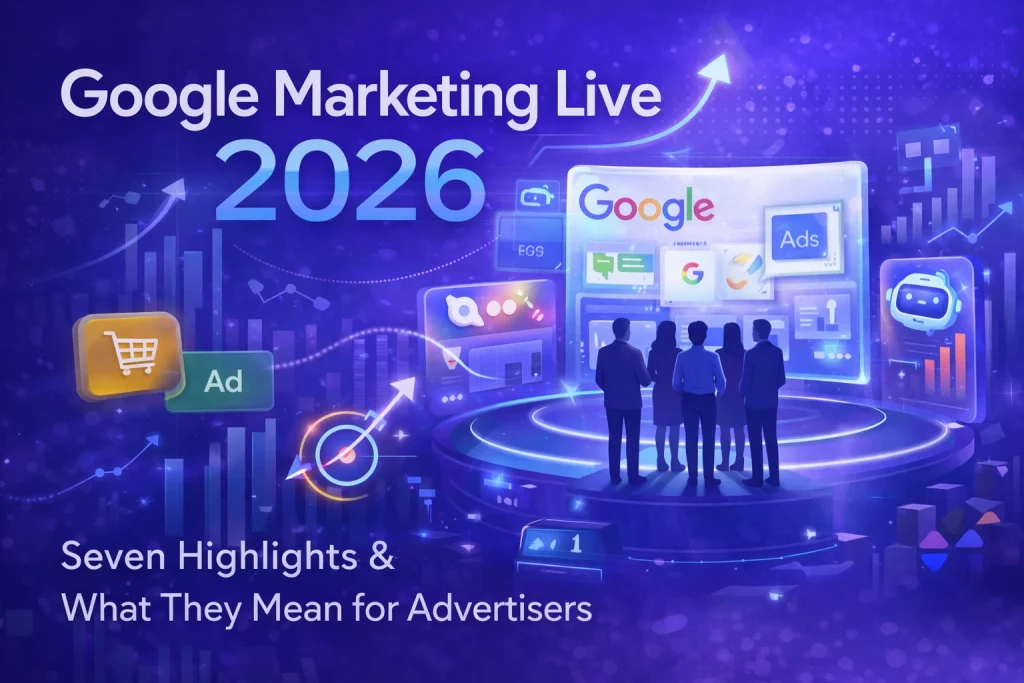
Quick Answer: Google Marketing Live 2026 is confirmed for May 20, 2026 – the same day as Google I/O. In 2025, Google delivered 30+ announcements in under 90 minutes. Based on what Google has shipped in the six months since, the 2026 keynote is likely to cover AI Mode advertising rollout, DSA deprecation in favour of AI Max, new agentic tools for campaign management, UCP commerce expansion, and upgraded creative generation with Gemini/Veo models. This post breaks down what to watch for – and what to do before the keynote drops.
Google Marketing Live is the event where Google resets the table for paid advertising. In 2025, a single 80-minute keynote introduced AI Max for Search, Smart Bidding Exploration, the Power Pack framework, ads in AI Overviews on desktop, the first demonstration of ads in AI Mode, and a new class of AI agents for campaign management. Almost every major change to Google Ads in the second half of 2025 traced back to an announcement made on May 21.
GML 2026 is scheduled for May 20 – one day after Google I/O begins on May 19, setting up a back-to-back week where Google’s broader AI announcements flow directly into its advertising product reveals. If I/O introduces new Gemini model capabilities or AI hardware, GML will show how those capabilities translate into advertising tools.
This post covers the confirmed facts about GML 2026, a grounded analysis of what is likely to be announced based on the patterns of 2025 and Google’s stated direction, and – most practically – what you can do this week to make sure your account is ready for whatever gets launched.
What We Know for Certain About GML 2026
The confirmed facts are limited but meaningful:
- Date:
May 20, 2026. Confirmed through an Accelerate with Google program email spotted by PPC News Feed editor Hana Kobzová in March 2026. The announcement also noted that Google Ads Impact Award winners will be revealed at the event.
- Format:
Virtual livestream, free to attend, accessible globally. Registration through the Ads on Air platform (adsonair.withgoogle.com). In-person components, when they exist, are typically limited to agency partners and select advertisers by invitation.
- Timing context:
GML 2026 falls on the final day of Google I/O 2026 (May 19–20). This overlap is intentional: Google I/O focuses on the broader technology ecosystem – Gemini model updates, developer tools, hardware reveals – and GML translates those capabilities into advertising products. Watching both gives the most complete picture.
- Scale:
In 2025, GML delivered more than 30 product announcements in approximately 80 minutes. Based on the pattern, 2026 will be at least as dense. This is a presentation designed for speed: individual features get 2–3 minutes each, and the full implications typically take weeks to unpack.
Sources: PPC News Feed ‘Google Marketing Live 2026 Scheduled for May 20’ (March 2026), Search Engine Land ‘Google Marketing Live 2026 Set for May 20’ (March 2026), ALM Corp GML 2026 preview (March 2026)
What GML 2025 Announced – The Baseline
Understanding GML 2026 requires knowing what GML 2025 set in motion, because most of what Google announces in May becomes the dominant story for the rest of the year.
The major announcements from May 21, 2025:
- AI Max for Search – the single biggest feature of the event. A suite enabling broader search term matching, text customization, and URL expansion for Search campaigns. This is now the primary vehicle for AI Mode ad eligibility.
- Smart Bidding Exploration – the ‘biggest update to bidding in over a decade’ per Google. Allows campaigns to temporarily lower ROAS targets to explore new queries. Average result: 18% increase in unique search query categories with conversions.
- Power Pack – the strategic framework replacing Power Pair. Performance Max (cross-channel) + AI Max for Search (intent capture) + Demand Gen (awareness). This is now Google’s official recommended campaign portfolio structure.
- Ads in AI Overviews expanded to desktop globally, and first demonstration of ads in AI Mode – signalling the trajectory that has continued into 2026.
- Asset Studio – Gemini-powered creative tools for generating headlines, images, and video within Google Ads using Imagen and Veo models.
- Agentic capabilities – Marketing Advisor (Chrome AI agent), Google Ads Expert, and Google Analytics Expert – early stage AI agents that assist with campaign setup, troubleshooting, and measurement.
- Channel Performance Reporting for Performance Max – the most requested PMax feature, entering open beta.
- Data Manager – unified first-party data hub connecting CRM sources (Salesforce, HubSpot, etc.) to Google Ads measurement.
🔍 The pattern from GML 2025: features announced in May appeared in limited beta by Q3 2025, expanded to general availability by Q4 2025, and became standard infrastructure by Q1 2026. Expect GML 2026 announcements to follow the same timeline – meaning that what Google announces on May 20 is what advertisers will be managing by November.
Sources: Google official GML 2025 recap (support.google.com), Wordstream ‘Google Marketing Live 2025: 10 Top Takeaways’, Search Engine Journal full recap (May 2025)
Five Likely Announcements at GML 2026
These are grounded predictions based on Google’s stated product direction, what is currently in beta or partial rollout, and what the gap analysis of 2025 announcements suggests is next. They are educated inferences, not confirmed leaks.
1. AI Mode Advertising: From Testing to General Availability
Ads in AI Mode have been in testing since late 2025, with early results reported as strong by Google’s VP of Retail Ads in April 2026 (Aritzia: +80% revenue lift). The infrastructure is fully built – Discovered Labs’ technical analysis in January 2026 confirmed complete ad delivery systems running in the background of every AI Mode session.
GML is the natural moment to announce the formal expansion of AI Mode ad placements to all eligible advertisers, introduce dedicated reporting for AI Mode performance, and potentially reveal new ad formats designed specifically for conversational search contexts (including the Direct Offers format already in limited testing with Poshmark and Reebok).
2. DSA Campaign Deprecation Announcement
Dynamic Search Ads (DSA) and AI Max for Search are functionally overlapping – both use website content and URLs rather than manual keywords to find matching queries. Google has been signalling this consolidation for over a year. ALM Corp’s 2025 year-in-review analysis predicted a ‘possible announcement in Q2 2026 with a 12–18 month migration period, similar to how Expanded Text Ads were phased out.’
If GML 2026 announces DSA deprecation, advertisers relying on these campaigns will have advance notice to migrate to AI Max for Search before the sunset date. This follows the same pattern as the ETA retirement (announced with lead time, executed gradually) and the Call-Only Ads deprecation (announced October 2025, first phase February 2026).
📌 If DSA deprecation is announced at GML 2026, start testing AI Max for Search on your key campaigns now. Advertisers who migrate early will have performance data and optimised setups before the deprecation deadline creates urgency.
3. Expanded UCP Commerce Features
The Universal Commerce Protocol – Google’s open standard for AI-powered shopping that enables checkout directly inside AI Mode – launched in January 2026 with initial partners including Etsy, Wayfair, Shopify, and Walmart. GML is likely to announce broader merchant rollout, new checkout capabilities, and expanded product categories.
For e-commerce advertisers, UCP integration potentially means customers can discover, evaluate, and purchase directly through Google’s AI interfaces without ever visiting a product page. This is structurally significant: it compresses the conversion funnel into the search experience itself.
4. Next-Generation Agentic Tools
GML 2025 introduced Marketing Advisor (the Chrome AI agent), Google Ads Expert, and Google Analytics Expert in early or limited beta. GML 2026 is likely to announce expanded capabilities, general availability, and possibly new agent types. Based on Google VP Vidhya Srinivasan’s annual letter (February 2026), which outlined an ‘agentic era where AI doesn’t just surface information but actively assists, recommends, and completes transactions,’ the trajectory points to agents that take autonomous actions in accounts – not just suggesting optimisations, but implementing them.
The implications for advertisers: more automation requires more strategic oversight, not less. The value of human expertise shifts from execution to direction-setting and quality control.
5. Creative Tools Upgrade: Veo 3 and Gemini 3 Integration
Google I/O 2026 (May 19–20, immediately before GML) will almost certainly include updates to Gemini and Veo models. GML will translate those capabilities into advertising features. In 2025, this meant Imagen 4 and Veo-powered Asset Studio. In 2026, expect: improved video generation quality, more sophisticated AI image editing within Google Ads, brand voice controls that extend beyond text to visual creative, and possibly AI-generated personalised creative variations at user-level scale.
What Is Probably Not Getting Announced
Managing expectations matters as much as building anticipation:
- Dedicated keyword-level reporting for AI Max – the nature of AI Max’s keywordless matching makes this structurally incompatible with traditional keyword reporting. Google’s direction is away from keyword-level granularity, not toward it.
- Manual CPC becoming the default again – Google’s entire platform strategy is built on Smart Bidding and AI-optimised automation. A reversal here is not in the product roadmap.
- Granular placement exclusions for AI Mode or AI Overviews – Google has signalled that advertiser control in AI surfaces will be limited, prioritising AI-determined relevance over manual placement selection.
- Third-party cookie re-enablement – Google’s Privacy Sandbox direction is settled. First-party data and Enhanced Conversions are the permanent framework going forward.
How to Watch and Where to Follow Live
- Live stream:
Register at adsonair.withgoogle.com (registration typically opens 2–3 weeks before the event). Free and open to all.
- Start time:
Based on 2025 format: 9:00 AM Pacific Time (12:00 PM Eastern, 5:00 PM London, 8:00 PM Yerevan). Duration approximately 80–90 minutes.
- Real-time coverage:
Search Engine Land, PPC News Feed, and Wordstream typically publish live blogs during the keynote. These are the fastest way to track announcements without watching the full stream.
- Post-event resources:
Google publishes a full keynote replay, written announcement summary, and product spotlight library at blog.google/products/ads-commerce following the event. This is the definitive reference document for everything announced.
How to Prepare Your Account Before May 20
New features announced at GML typically have eligibility requirements that may take time to meet. Getting your account ready now means you can act immediately when new tools become available, rather than spending the following weeks catching up on prerequisites.
Enable AI Max for Search on at least one campaign
AI Max is the primary vehicle for AI Mode ad placements and is expected to be central to several GML 2026 announcements. If you have not tested it yet, start now. Use Google’s built-in 50/50 experiment mode on your highest-volume campaign. Even 4 weeks of data before GML gives you a baseline to compare against whatever changes the keynote introduces.
Verify your conversion tracking stack
Every major Google Ads capability announced in the past 18 months depends on clean conversion signals: Smart Bidding, AI Max, Performance Max, attribution in AI surfaces, agentic tools. A broken tracking setup becomes a compounding problem as automation takes a larger role. Check Enhanced Conversions is active, CAPI is implemented if you are running Meta, and Event Match Quality is above 6.0.
Ensure Performance Max campaigns have current asset quality
PMax asset A/B testing is now generally available. If you have not run an experiment yet, set one up before GML – you will have preliminary results to inform decisions about any new PMax features announced on May 20.
If you rely heavily on DSA campaigns, start testing AI Max
The risk of being caught off-guard by a DSA deprecation announcement is real. Test AI Max for Search as a replacement for your DSA traffic now. The migration is straightforward and the performance comparison data you generate between now and GML will be useful regardless of what Google announces.
💡 The best preparation for any GML announcement is not anticipating specific features – it is having a well-structured account with clean tracking, mature campaign learning phases, and enough conversion volume for algorithms to work with. Accounts in that state can absorb new feature releases and test them quickly. Accounts with fundamental issues cannot.
FAQ
Where can I watch Google Marketing Live 2026?
Register at adsonair.withgoogle.com. The event is a free virtual livestream. Based on GML 2025 format, it runs approximately 80–90 minutes starting at 9:00 AM Pacific Time on May 20. A replay is published immediately after the event on the same platform, along with a written summary on Google’s official Ads blog.
Should I pause campaigns or change anything in my account on the day of GML?
No. GML announcements typically describe features in limited beta, planned expansion, or general availability – not immediate account-level changes that take effect the same day. Pause your campaigns only if you have a business reason to do so. The right response to GML announcements is to add them to your testing roadmap, not to make reactive account changes on the day of the event.
How quickly after GML can I start using new features?
It varies significantly. Based on the 2025 pattern: features in closed beta at GML expanded to general availability within 3–6 months. Features described as ‘launching today’ were typically in open beta by the time of the announcement. Features described as ‘coming soon’ may take 6–12 months. The Google Ads Help Centre and official Ads blog are the definitive sources for availability timelines.
Will GML 2026 affect my current campaign performance?
The event itself will not change your campaign performance. Feature announcements at GML are not retroactively applied to existing campaigns. New capabilities typically require explicit opt-in or configuration. What can affect performance is if you make reactive changes to your campaigns in response to announcements before you have had time to properly evaluate and test them.
The Bottom Line
Google Marketing Live is the moment where Google’s advertising roadmap for the next 12 months becomes visible. Not everything announced will affect every advertiser – but the features that do land in general availability shape the competitive environment for the rest of the year.
The advertisers who benefit most from GML are not those who react the fastest on the day of the event. They are the ones who arrive with well-structured accounts, clean tracking, and a clear understanding of how current features work – so that new capabilities can be evaluated and implemented thoughtfully, not hastily.
May 20 is six days away. The best thing you can do before the keynote is make sure your account fundamentals are solid. Everything else can wait until after the announcement dust settles.
→ Not sure whether your Google Ads account is structured to take advantage of AI-era features as they roll out? Optimyzee analyses your campaign architecture and keyword organisation – giving you a clear picture of where to focus before and after GML 2026.
Sources
PPC News Feed: ‘Google Marketing Live 2026 Scheduled for May 20‘ (March 2026) – first reporting of confirmed date
Search Engine Land: ‘Google Marketing Live 2026 Set for May 20‘ (March 2026)
ALM Corp: ‘Google Marketing Live 2026: Date Confirmed for May 20‘ – comprehensive preview (March 2026)
Google Ads Help: ‘Google Marketing Live 2025: Your Roundup of Announcements‘ (May 2025) – official GML 2025 recap
Wordstream: ‘Google Marketing Live 2025: 10 Top Takeaways + Early Reactions‘ (May 2025)
Search Engine Journal: ‘Google Marketing Live 2025: Everything You Need to Know’ (June 2025)
ALM Corp: ‘Google Ads 2025 Year-in-Review’ – DSA deprecation prediction and roadmap analysis (December 2025)
Modern Retail: Interview with Courtney Rose, VP Retail at Google Ads (April 2026) – AI Mode early results
Discovered Labs: AI Mode technical analysis – UCP and ad infrastructure readiness (January 2026)
Search Engine Land: ‘Google Outlines AI-Powered, Agent-Driven Future for Shopping and Ads in 2026’ (February 2026)