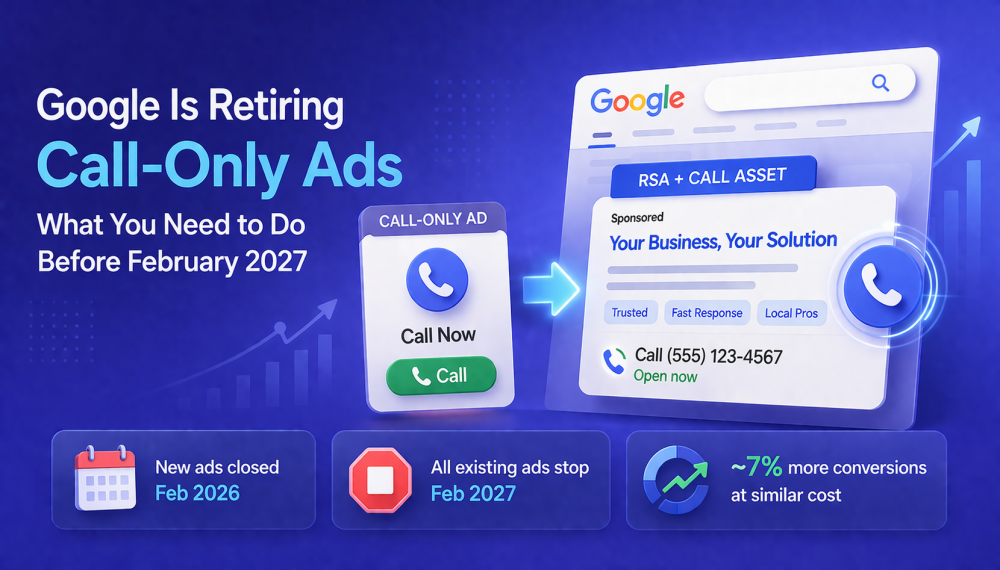
Google announced in October 2025 that Call-Only Ads are being retired. New call-only ads could not be created after February 2026. All existing call-only ads will stop serving impressions in February 2027. The replacement: Responsive Search Ads (RSAs) with Call Assets. Early migrators report an average 7% more conversions at similar cost. If you rely on phone calls for leads, this affects you directly.
If your business runs on phone calls – local services, legal, medical, real estate, home improvement, B2B with long sales cycles – Google Ads has been sending you a clear signal since October 2025: this call-only ads deprecation is happening, and the clock is ticking.
The format that let businesses show nothing but a phone number and a call button in search results, without requiring a website URL, is being retired. From February 2026, creating new Call-Only Ads is no longer possible. From February 2027, all existing ones stop serving – permanently.
This post explains exactly what’s changing, why Google made this move, what replaces Call-Only Ads, and how to migrate without losing call volume or lead quality. The process is less complicated than it might sound, and the earlier you do it, the more performance data you build before the hard deadline.
What Are Call-Only Ads and Who Uses Them?
Call-Only Ads (also called Call Ads) are a Google Ads format designed specifically to generate phone calls rather than website visits. When someone clicks the ad on mobile, it initiates a phone call directly – there is no landing page, no website click, just a call.
They have been particularly valuable for:
- Local service businesses: plumbers, electricians, HVAC, cleaning services
- Professional services: legal, medical, dental, financial advisors
- High-consideration purchases: real estate, insurance, home renovation
- Emergency services where speed of contact matters
- Businesses with no website or limited web presence
The format’s simplicity was its strength: no need to optimise a landing page, direct path from search intent to phone contact. Its weakness – no URL requirement – also made it a vector for fraud. According to PPC Land, thousands of fraudulent call-only ads have been deployed using fake phone numbers to run scam call centres, with Google struggling to police them effectively.
The Call-Only Ads Deprecation Timeline – Exact Dates
Google announced the deprecation on October 3, 2025. The two-phase timeline:
February 2026: All options to create new Call-Only Ads were removed from the Google Ads interface and API. If you have existing Call-Only Ads, they continue running for now.
February 2027: All existing Call-Only Ads stop receiving impressions entirely. This is the hard deadline – after this date, the format ceases to exist in Google Ads.
⚠️ If you are still running Call-Only Ads and have not started migration, you have approximately 10 months before the final shutdown. Starting now gives you time to test, optimise, and ensure your call volume is maintained before the format disappears.
Source: Google Ads Help – ‘Action Required: Transition from call ads to call assets’ (support.google.com, October 2025)
Why Google Is Retiring This Format
Google has framed the deprecation as part of a broader shift toward AI-optimised, asset-based advertising. The company’s direction since 2022 has been to move advertisers away from fixed ad formats (Expanded Text Ads, Call-Only Ads) toward flexible asset pools where Google’s AI assembles the best combination for each query and user.
In practical terms:
- Call-Only Ads provide a single fixed ad with no ability for machine learning to test combinations or adapt to different search contexts
- RSAs with Call Assets give Google’s AI more inputs – multiple headlines, descriptions, plus a call asset – enabling dynamic optimisation across different queries, devices, and times of day
- The removal also addresses the fraud issue: RSAs require website URLs, making it harder for fraudulent operators to use the format without a legitimate web presence
This follows a pattern: Google deprecated Expanded Text Ads in 2022, Similar Audiences in 2023, and Enhanced CPC bidding in 2024–2025. Each retirement has pushed advertisers toward formats where AI has more signals to work with.
What Replaces Call-Only Ads: RSAs with Call Assets
The replacement is not a new ad type – it is a combination of two existing features working together:
Responsive Search Ads (RSAs)
RSAs are Google’s default search ad format. You provide up to 15 headlines and 4 descriptions. Google’s AI tests different combinations to find what performs best for each search query, user, and context. Unlike Call-Only Ads, RSAs can show a headline click through to a landing page – which is more flexible for users who prefer to research before calling.
Call Assets
Call Assets (formerly Call Extensions) add a clickable phone number to your RSA. On mobile, users can tap the number to call directly. On desktop, the number displays for users to dial manually. You can schedule Call Assets to show only during business hours, set call duration thresholds for conversion tracking, and configure call reporting to measure lead quality.
Together, RSAs with Call Assets replicate the core function of Call-Only Ads – driving phone calls from search – while adding flexibility: users can choose to click through to your website or call directly, and Google’s AI can optimise which option to surface based on predicted intent.
📊 Performance data: Advertisers who migrated early from Call-Only Ads to RSAs with Call Assets report an average of 7% more conversions at similar cost, according to 1ClickReport analysis of early migration accounts (February 2026). The improvement comes from Google’s AI optimising creative combinations across a larger audience pool.
Source: 1ClickReport – ‘Google Ads Call-Only Ads Deprecated 2026: RSA Guide’ (February 2026)
Call-Only Ads vs RSAs with Call Assets: Key Differences
Format: Call-Only = fixed, single format. RSA = dynamic, AI-tested combinations.
URL requirement: Call-Only = no URL needed. RSA = final URL required.
User options: Call-Only = call only. RSA with Call Asset = call or click to website.
AI optimisation: Call-Only = none. RSA = continuous headline/description testing.
Placement: Call-Only = mobile search only. RSA with Call Asset = mobile and desktop.
Conversion tracking: Call-Only = basic. RSA = full call reporting with duration thresholds and CRM integration.
Step-by-Step Migration Guide
Step 1: Audit Your Existing Call-Only Ads
Before creating anything new, document what you have:
- List all campaigns and ad groups running Call-Only Ads
- Record your current performance benchmarks: call volume, cost per call, call conversion rate, average call duration
- Note which times of day generate the most calls (important for Call Asset scheduling)
- Export your keyword lists, match types, bid strategies, and geographic targeting
- Check your call conversion tracking setup – is it recording accurately?
Step 2: Set Up Call Assets
In Google Ads, navigate to Assets (formerly Extensions) and create a Call Asset:
- Add your business phone number
- Set a call reporting schedule matching your business hours – this prevents calls outside hours you can answer from being counted as conversions
- Set the minimum call duration threshold for a call to count as a conversion (60–90 seconds is standard for most service businesses)
- Enable call recording if available in your market and compliant with local regulations
Apply the Call Asset at the campaign or ad group level, depending on whether different campaigns use different phone numbers.
Step 3: Create RSAs for Each Ad Group
For each ad group that previously ran Call-Only Ads, create a new RSA:
- Write 10–15 unique headlines. Include your primary keywords, your unique selling points, and several that work as a standalone call to action (‘Call Us Today’, ‘Speak to an Expert’, ‘Free Consultation Available’)
- Write 3–4 descriptions. At least one should include your phone number and reinforce why calling is the right next step
- Add your website URL – this is required for RSAs. If you have no landing page, create a simple contact page
💡 Write headlines that work with OR without the Call Asset showing. Google’s AI may show your RSA without the call extension in some contexts. If all your headlines assume the user sees the phone number, the ad reads poorly when the asset doesn’t appear.
Step 4: Run Both Formats in Parallel (2–4 Weeks)
Do not pause your Call-Only Ads immediately. Run your new RSAs alongside them for 2–4 weeks:
- Compare call volume, cost per call, and lead quality between the two formats
- Watch for any increase in CPC or decrease in impression share during the transition
- Verify Call Asset scheduling is working correctly – check that calls are not coming in outside business hours
Step 5: Pause Call-Only Ads Once RSA Performance Is Stable
Once your RSAs are generating comparable or better call volume at similar cost, pause your Call-Only Ads. Do not delete them immediately – keep them paused until after February 2027 so you retain the historical performance data for benchmarking.
What to Track After Migrating
Set up a comparison dashboard in Google Ads or your reporting tool covering:
- Phone call conversions – total calls meeting your duration threshold
- Cost per call conversion – compare to your Call-Only Ads baseline
- Call conversion rate – calls divided by ad impressions
- Call Asset click rate – how often users click the call button vs. the headline
- Quality Score changes – RSAs typically improve QS over time as Google learns which combinations work
- Impression share – ensure the transition has not reduced your presence in the auction
Common Migration Mistakes to Avoid
Pausing Call-Only Ads too early
Run both formats in parallel for at least 2 weeks before switching off. Abrupt changes disrupt Smart Bidding’s learning period.
No Call Asset scheduling
If your Call Asset shows 24/7 but your team only answers calls during business hours, you’re paying for calls you can’t convert. Set strict scheduling.
Only writing call-focused headlines
Remember that RSAs also show as standard click-through ads without the Call Asset. Write headlines that work both ways.
Skipping call conversion tracking setup
Without proper tracking, Google’s Smart Bidding has no signal to optimise for call quality – it will optimise for call volume regardless of lead value.
Using a generic phone number across all campaigns
If you track call quality and different campaign types generate different lead quality, use separate numbers per campaign so you can measure and adjust.
FAQ
My Call-Only Ads are still running – does that mean I don’t need to act?
Not quite. Call-Only Ads created before February 2026 continue serving until February 2027 – but you cannot create new ones or duplicate them. More importantly, starting your RSA migration now gives you time to test, optimise, and build performance data before the hard cutoff. Advertisers who wait until late 2026 will be migrating under pressure with no time to fix problems.
Do RSAs with Call Assets perform as well as Call-Only Ads for generating phone calls?
Based on available migration data, RSAs with Call Assets can match or exceed Call-Only Ad performance for phone calls. Advertisers who migrated early report approximately 7% more conversions at similar cost on average (1ClickReport, February 2026). The improvement comes from Google’s AI testing headline and description combinations across a broader audience. That said, performance varies by industry and account – running both formats in parallel before switching is the only way to validate results for your specific campaigns.
What if I don’t have a website?
RSAs require a final URL, which Call-Only Ads did not. If you have no website, a simple one-page site with your business name, phone number, and a brief description of services is sufficient. Google does not require a high-quality landing page for RSA eligibility – it just needs a valid URL. Creating a basic contact page on a free platform (Google Sites, Squarespace, WordPress) is enough to meet the requirement.
Can I still show only a phone number without a website link?
Not with the same prominence as Call-Only Ads. RSAs with Call Assets will show both a headline link and a phone number. On mobile, the call button is prominent and easy to tap. The click-to-call experience is preserved – users just also have the option to visit your site if they prefer.
What happens if I don’t migrate before February 2027?
All Call-Only Ads, including any still running, will simply stop receiving impressions. They will not be paused or archived – they will go dark. If your call volume depends on these campaigns and you haven’t built replacement RSAs, you will experience an immediate drop in call leads with no transition period.
The Bottom Line
Call-Only Ads are a legacy format in a platform that has moved firmly toward AI-optimised, asset-based advertising. This call-only ads deprecation is not a surprise – it follows a clear multi-year pattern of Google consolidating older fixed formats into flexible RSA-based systems where machine learning can do more.
The practical reality: RSAs with Call Assets are not a downgrade. They offer more flexible user experience, better conversion tracking, and access to Google’s AI optimisation that Call-Only Ads never had. For most advertisers who rely on phone calls, the migration will deliver equal or better performance within the first few weeks.
The risk is not in the new format – it’s in waiting. Every month you don’t start is a month less of performance data before February 2027, and less time to identify and fix any issues with your new setup.
→ Already running Google Ads campaigns for call-based lead generation? Optimyzee can analyse your current campaign structure, keyword organisation, and ad setup to ensure your RSA migration is built on a solid foundation. If you’re also updating your conversion tracking setup, do that first – accurate call conversion data is what your new RSAs need to optimise correctly.
Sources
Google Ads Help: ‘How to transition from call ads to call assets’ – support.google.com
PPC Land: ‘Google ends call ads in February 2026, shifts advertisers to RSA format’ (October 2025)
Search Engine Land: ‘Google to phase out Call-Only Ads by 2027’ (October 2025)
Symphonic Digital: ‘Google Ads Playbook for 2026 – Call-Only Sunset’ (January 2026)
Searchen Networks: ‘Google Sets Deadline to Retire Call-Only Ads’ (January 2026)