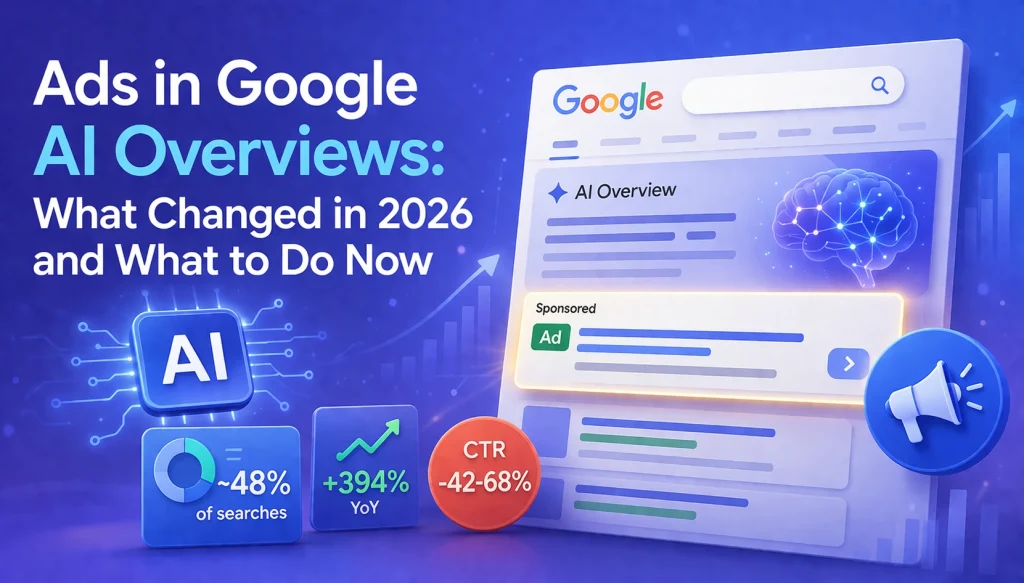
Ads in Google AI Overviews now appear on ~48% of all Google queries (BrightEdge, March 2026). Ads appear alongside 25.5% of those results – up 394% year-over-year. Organic CTR drops 42–68% when an AI Overview is present. Your ads may already be showing inside AI Overviews if you run PMax or broad match Search campaigns. Here’s what it means and what to do about it.
Google Search results look different in 2026 than they did 18 months ago. At the top of many results pages sits an AI-generated summary – a synthesised answer pulled from multiple sources – before any organic link or traditional ad. Google calls these AI Overviews, and they are now part of nearly half of all searches.
For advertisers, this creates both a problem and an opportunity. The problem: organic CTR is falling sharply on affected queries. The opportunity: Google has been quietly placing ads inside and around these AI-generated summaries – and if your campaigns are set up correctly, you may already be benefiting without knowing it.
This post covers the current state of AI Overviews as of April 2026, what the data shows for both organic and paid performance, how ad placement works, and – most importantly – what advertisers should do right now.
What Are AI Overviews and How Widely Are They Deployed?
AI Overviews launched in the United States in mid-2024, initially for mobile users, and expanded to desktop and over 100 countries through 2025. As of March 2026, BrightEdge data tracking more than 200,000 keywords shows AI Overviews appearing on approximately 48% of all Google search queries – up 58% from December 2025 alone.
The expansion has not been uniform across query types. Commercial queries with clear purchase intent see AI Overviews less frequently than informational queries. According to Semrush research from 2025, nearly 95% of keywords that trigger AI Overviews have either no paid ads or minimal commercial value – Google appears to be protecting its most lucrative ad inventory while experimenting with AI on informational searches.
📌 What this means in practice: AI Overviews most commonly appear for research-phase queries (‘what is the best…’, ‘how does X work’, ‘compare A vs B’). For high-intent transactional queries (‘buy X’, ‘X near me’, ‘X price’), traditional search results still dominate.
Sources: BrightEdge (March 2026), Semrush AI Overviews Study (2025)
What the Data Shows: Organic and Paid CTR Impact
The Organic Picture
The data on organic traffic impact is significant enough that advertisers need to understand it even if their primary concern is paid search.
Seer Interactive analysed over 25 million organic impressions and found that organic CTR dropped 61% on queries where AI Overviews appeared – falling from an average of 1.76% to just 0.61%.
Ahrefs, in a study of 300,000 keywords published in early 2026, confirmed that AI Overviews correlate with a 58% lower CTR for top-ranking organic pages. The sharpest impact is at position 1: CTR dropped from 7.6% to 3.9% – a 49% decline for the single most valuable organic position.
The implication for advertisers who rely on SEO for traffic: paid search has become more important as organic visibility shrinks, while the pool of clicks available on affected queries is also shrinking. This puts a premium on being in the right ad placement.
The Paid Search Picture
Paid CTR has also been affected, though the dynamics are different. Seer Interactive’s analysis found paid CTR dropped 68% on queries with AI Overviews – from 19.7% to 6.34%. This is a larger percentage decline than organic, but paid ads still command significantly higher absolute CTR than organic on commercial queries.
The more important data point for advertisers: Google Search generated $63 billion in Q4 2025 revenue, growing 17% year-over-year. Ad revenue is not declining – it is shifting to new placements within the AI search experience.
Sources: Seer Interactive (25M impressions analysis), Ahrefs keyword study (early 2026), Google Q4 2025 earnings
How Ads in AI Overviews Actually Work
Google did not launch ads in AI Overviews with a single announcement. The rollout has been gradual and somewhat opaque, which is why many advertisers are either unaware they are already showing in these placements, or uncertain whether the feature is even available to them.
The timeline: Google began testing in-overview ads in October 2024 for US mobile users. The feature expanded significantly at Google Marketing Live in May 2025, where VP Vidhya Srinivasan confirmed that Google’s AI can detect commercial intent even in queries that do not seem explicitly commercial. By early 2026, ads can appear in three positions relative to AI Overviews.
💡 Key insight: You do not apply for access to AI Overview ad placements. Eligibility is determined automatically based on your campaign setup, ad quality, and relevance to the query and the AI-generated answer. If you’re running Performance Max or broad match Search campaigns with strong Quality Scores, you may already be appearing in these placements.
Three Ad Positions You Need to Know
1. Above the AI Overview
Standard top-of-page placement, unchanged from traditional search. Available globally across all 200+ markets where AI Overviews exist. These ads appear before users read the AI-generated summary.
2. Below the AI Overview
Ads appear after the AI-generated content, above the organic results. Also available globally. These ads reach users who have already read the AI summary and are still considering their options – potentially higher purchase intent than above-the-fold impressions.
3. Within the AI Overview
The most novel placement: ads embedded directly inside the AI-generated summary as sponsored product or service recommendations. Currently live in English in the US on mobile and desktop. Global expansion is expected throughout 2026.
Monitoring platform Adthena scanned 25,000 search results and detected this placement appearing at a frequency of approximately 0.052% – Google is being extremely selective. Qualifying requires high relevance not just to the query, but specifically to the content of the AI-generated answer.
Source: Adthena (25,000 SERP analysis), Google official announcements (2025–2026)
How to Qualify for AI Overview Ad Placements
Google has not published a formal checklist for AI Overview ad eligibility. Based on available guidance and observed patterns, the following factors appear to determine which campaigns qualify:
- Performance Max campaigns:
PMax is Google’s preferred vehicle for AI Overview placements. Its cross-channel structure and reliance on asset quality align with how Google’s AI evaluates relevance for these new surfaces.
- Search campaigns with broad match + Smart Bidding:
Broad match allows Google’s AI to match your ads to the wider range of queries that trigger AI Overviews, including research-phase and informational queries that express commercial intent. Smart Bidding provides the conversion signals Google needs to decide when to show your ads.
- AI Max for Search:
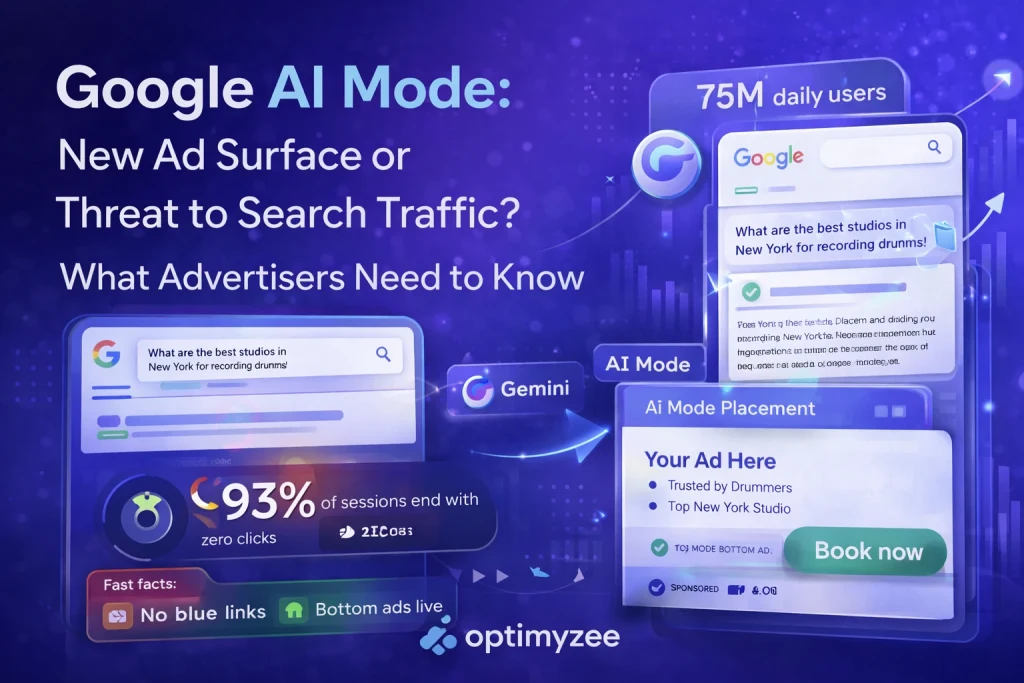
Campaigns using AI Max are expected to see AI Overview and AI Mode placements enabled automatically as Google expands these surfaces. Google’s VP confirmed in February 2026 that 2026 is the year ads in AI Mode move from experimental to mainstream.
- High-quality creative assets:
Google’s AI selects ads that are relevant to the specific answer it has generated. Generic ad copy that doesn’t align with the user’s research intent will not qualify. Assets need to match the informational context of AI-generated summaries, not just the keyword.
⚠️ What does NOT guarantee qualification: high bids, high impression share on traditional queries, or long account history. Relevance to the AI-generated content is the primary filter, not historical account authority.
What You Can (and Can’t) Measure
This is where advertisers face a genuine challenge. As of April 2026, Google does not provide segmented reporting for ads shown within AI Overviews versus traditional placements. Ads in AI Overviews are reported as ‘Top Ads’ in your account, but you cannot isolate their performance metrics separately.
What you can observe:
- Changes in impression share on queries that typically trigger AI Overviews
- Overall Top Ads impression share and position-above-rate trends
- Performance shifts in campaigns running PMax or broad match after AI Overview expansion events
- Search term report entries that include research-phase and informational queries – a signal that AI Overview placements are being matched
Google has signalled that dedicated reporting for AI Overview and AI Mode placements is coming as these surfaces mature. For now, the absence of granular data makes it difficult to measure incremental lift specifically from this placement.
🔧 Practical workaround: Create a separate campaign or ad group targeting the research-phase queries where AI Overviews commonly appear on your key topics. Track its performance separately to build a baseline before Google ships dedicated placement reporting.
Practical Action Plan for Advertisers
- Audit your current placement exposure
Review your Search Term Report for informational and research-phase queries. If you’re seeing impressions on ‘how to’, ‘what is’, ‘best X for Y’ type queries, your ads are likely appearing in AI Overview territory already.
- Ensure Performance Max is in your campaign mix
PMax is Google’s primary vehicle for AI-surface ad placement. If you’re running Search-only campaigns, you are missing a significant portion of the AI Overview inventory – particularly the within-overview placement.
- Improve asset relevance for research-phase intent
Review your RSA headlines and PMax assets. Do any speak directly to users in research mode – explaining what your product does, why it’s the right choice, what differentiates it? AI Overviews serve users who are evaluating options, not just ready to buy.
- Test AI Max for Search on your highest-volume campaigns
AI Max campaigns are expected to receive priority access to AI Mode ad placements as they roll out. Starting the experiment now – using Google’s built-in 50/50 traffic split – positions you ahead of the curve before these placements become more competitive.
- Track branded search volume as a proxy for AI visibility
Research from Semrush shows that pages cited in AI Mode see increased branded search activity even when direct clicks are not captured. Monitor branded impressions and direct traffic as indirect indicators of AI surface visibility.
FAQ
Do I need to apply or opt in to get ads in AI Overviews?
No. There is no opt-in process. Eligibility is determined automatically based on your campaign setup, ad quality, and relevance. Performance Max campaigns and Search campaigns using broad match with Smart Bidding are the primary vehicles. If your campaigns meet the quality thresholds, your ads may already be appearing in these placements.
Which campaign types are eligible for AI Overview ad placements?
Performance Max is Google’s primary recommended vehicle. Search campaigns using broad match with Smart Bidding strategies (Target CPA, Target ROAS, Maximize Conversions) are also eligible. Manual CPC campaigns have limited eligibility. AI Max for Search campaigns are expected to receive automatic access to AI Mode placements as they expand.
Can I see how my ads are performing specifically in AI Overviews?
Not yet with full granularity. As of April 2026, Google reports AI Overview ad impressions under ‘Top Ads’ without separate segmentation. Dedicated reporting for AI-surface placements is expected to arrive as Google matures these products. In the meantime, monitor Search Term Reports for research-phase queries and watch Top Ads impression share trends.
Are AI Overview placements more expensive than traditional search placements?
Google has not released CPC data specifically for AI Overview placements. Since these placements are determined by AI relevance rather than bid alone, it is not straightforward to bid higher specifically to appear in them. Focus on asset quality and campaign structure first; bid strategy is secondary.
Will AI Overviews make Google Ads less effective overall?
The data does not support this conclusion for paid search. Google’s Q4 2025 search revenue grew 17% year-over-year despite AI Overview expansion. The channel is shifting – organic traffic is declining on affected queries, but paid impressions are moving into new placements within the AI experience. Advertisers who adapt their campaign structure and asset strategy are finding new inventory, not losing it.
The Bottom Line
AI Overviews are not a future trend – they are the current reality of Google Search in 2026. With appearances on nearly half of all queries and organic CTR falling by up to 61% on affected results, the pressure on advertisers to understand and adapt to this environment is real.
The good news: Google is not reducing ad inventory. It is expanding it into new surfaces. Advertisers who run Performance Max, use Smart Bidding, maintain high asset quality, and test AI Max are best positioned to capture this emerging placement inventory before it becomes as competitive as traditional search positions.
The practical starting point is simpler than it might sound: audit your existing Search Term Report for research-phase queries, check whether PMax is in your campaign mix, and review whether your ad assets speak to users who are still evaluating their options – not just those already ready to buy.
→ Want to see how your campaigns are structured for AI-era search? Optimyzee analyses your account structure and keyword organisation to ensure you’re set up to capture the traffic that matters.
Sources
BrightEdge: AI Overviews tracking data, March 2026 (brightedge.com)
Semrush: AI Overviews Study – 10 Million Keywords (semrush.com/blog)
Seer Interactive: 25 million organic impressions analysis – CTR impact of AI Overviews
Ahrefs: 300,000 keyword CTR study (early 2026)
Google: Q4 2025 Earnings Report – Search revenue $63B, +17% YoY
Google Ads Help: AI Overviews expansion announcement (support.google.com/google-ads)
Adthena: 25,000 SERP analysis – in-overview ad frequency
Google VP Vidhya Srinivasan: Google Marketing Live 2025 keynote