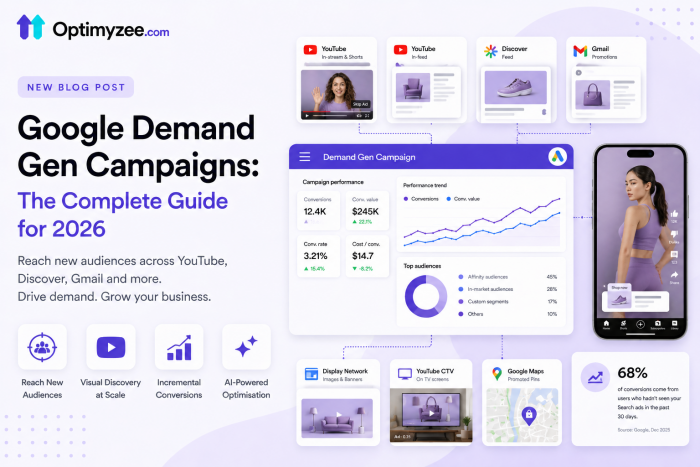
Quick Answer: Demand Gen is Google’s AI-powered campaign type for visual discovery advertising – running across YouTube (including Shorts and CTV), Google Discover, Gmail, and Google Display Network. It replaced Discovery Ads and Video Action Campaigns. In 2025, Demand Gen delivered a 26% increase in conversions per dollar (Google internal data). Its key differentiator: 68% of its conversions come from users who had not seen the brand’s Search ads in the prior 30 days – meaning it reaches genuinely incremental audiences that Search and PMax don’t capture alone.
Demand Gen is the most underused campaign type in Google Ads, and that gap is widening. Most advertisers who run it treat it as a slightly upgraded version of the old Discovery Ads – set up once, let it run, check the ROAS, get disappointed, turn it off.
That is the wrong model. Demand Gen is not a Search campaign measured on the same metrics. It is not a Performance Max substitute. It is a distinct channel designed to create demand at the top of the funnel – generating awareness and consideration among audiences who are not yet searching for your product. Its job is to make Search campaigns easier, not to replace them.
This guide covers what Demand Gen actually is in 2026, where it runs, what has changed significantly since it launched, how to set it up correctly, and how to measure it in a way that reflects its actual contribution to your business.
What Is Demand Gen and Where Did It Come From?
Demand Gen launched at Google Marketing Live 2023 as the successor to Discovery Ads – the campaign type that ran in Gmail, Discover, and YouTube feeds. By March 2024, Discovery Ads were fully replaced. In July 2025, Google absorbed Video Action Campaigns into Demand Gen, making it the single home for all visual, engagement-driven advertising across Google’s properties.
The fundamental principle: Demand Gen targets people before they search. Where Search campaigns capture users who already know they want something, Demand Gen puts your product in front of people who might want it – based on who they are, what they watch, and how they behave – before any purchase intent has formed.
Thomas Eccel, a recognised Demand Gen specialist, summarised it clearly in Lunio’s 2026 strategy guide: ‘Demand Gen is here to create intent. Performance Max is here to capture it. When you let each one do its job, everything works better.’
Source: Lunio ‘Google Demand Gen Strategy Guide for 2026’ featuring Thomas Eccel (January 2026)
Where Demand Gen Ads Appear in 2026
As of 2026, Demand Gen runs across the following inventory – significantly more than when it launched:
| Placement | Format | Notes |
| YouTube in-stream | Skippable and non-skippable video | Standard pre-roll and mid-roll placement |
| YouTube Shorts | Vertical video (9:16) | Added channel control in 2025 – can target Shorts only |
| YouTube in-feed | Thumbnail + headline | Appears in search results and browse feeds |
| YouTube CTV (TV screens) | Horizontal video | Shoppable CTV added January 2026 – +7% conversions |
| Google Discover | Images and video | Mobile feed, high-intent browsing context |
| Gmail (Promotions + Social) | Native image/text format | Appears in inbox, expandable |
| Google Display Network | Image ads | Added 2025 – 90%+ of global internet population |
| Google Maps (promoted pins) | Location-aware | New in 2026 – local intent, location-driven businesses |
📌 Channel controls were introduced in 2025 – you can now choose exactly which of these placements to include or exclude. This is a significant improvement over the previous all-or-nothing approach. Start with YouTube + Discover only, then add other channels once you have performance data from the core placements.
Sources: Google Ads Help ‘Google Ads Highlights of 2025’, groas.ai ‘Google Ads Demand Gen Campaigns: The Complete 2026 Guide’ (February 2026)
What Has Changed: The 2025–2026 Updates
Demand Gen has evolved faster than most campaign types in the past 18 months. Google introduced a programme called ‘Demand Gen Drops’ in September 2025 – monthly product update showcases specifically for Demand Gen. Here is what has landed:
September 2025 Drop
- Conversion Lift measurement expanded to lower spend levels – incrementality testing now accessible outside enterprise tier
- Omni-Channel Smart Bidding for store conversions – optimisation for both online and offline sales simultaneously
- New reporting columns matching social platform attribution formats – direct signal that Google is competing for Meta budgets
November 2025 Drop
- AI creative enhancements – auto-generated video from images and text assets
- A/B experiments now available across all Demand Gen bid strategies
- Brand suitability controls – category exclusions and content sensitivity settings
December 2025 Drop
- Channel controls – granular placement selection per campaign
- Local offers – in-store availability information in ads
- Key finding published: 68% of Demand Gen conversions come from users who had not seen the brand’s Search ads in the prior 30 days
January 2026 Drop
- Shoppable Connected TV – product feed integration on YouTube’s TV inventory
- Travel Feeds – dedicated inventory for hospitality and tourism advertisers
- Attributed Branded Searches – new metric showing how many branded Google and YouTube searches your Demand Gen campaigns directly generate
March 2026 Drop
- Creator partnership integration – YouTube creator ad inventory; +30% conversion lift for campaigns using Shorts creator inventory (Google internal data, Jan 2025–Jan 2026)
Sources: ALM Corp ‘Google’s February 2026 Demand Gen Best Practices’ (March 2026), groas.ai Demand Gen complete guide, Google official Demand Gen Drops announcements
Performance Data: What the Numbers Actually Show
Demand Gen’s performance data needs to be understood in the right context – it is not a Search campaign, and measuring it like one produces misleading conclusions.
| Metric | Data Point | Source |
| Conversions per dollar improvement | +26% year-over-year (2025) | Google internal, 60+ AI improvements |
| ROAS vs Video Action Campaigns | +58% higher ROAS | Google internal data |
| Incremental audience reach | 68% of conversions from users NOT in Search campaigns | Google December 2025 Drop |
| CTV uplift | +7% additional conversions including TV screens | Google January 2026 Drop |
| Creator partnerships on Shorts | +30% conversion lift at equivalent CPA | Google internal, Jan 2025–Jan 2026 |
| New Customer Only Mode | +11.5% improvement in new-to-returning ratio, -3% new customer CPA | Google A/B test data, Mar–May 2025 |
The 68% incremental audience figure deserves particular attention. It directly addresses the most common objection to Demand Gen: ‘aren’t these users who would have converted through Search anyway?’ The data says no – the majority of Demand Gen conversions come from users who had no Search ad exposure in the prior 30 days. Demand Gen is accessing audiences that Search campaigns never reach.
🔍 The right benchmark for Demand Gen is not ‘does this match my Search ROAS?’ It is ‘is this reaching users I wouldn’t otherwise convert, at a cost that makes sense given their lifetime value?’ Those are fundamentally different questions, and only the second one correctly evaluates Demand Gen’s contribution.
How to Set Up a Demand Gen Campaign Correctly
Campaign objective and bidding
Demand Gen supports three primary bidding strategies in 2026:
- Maximize conversions:
best for campaigns without a specific CPA target, or when starting a new campaign without historical data.
- Target CPA:
once you have 50+ conversions per week, this focuses spend on the most efficient acquisition cost.
- Target ROAS:
for e-commerce with conversion value tracking; requires sufficient value data to optimise toward revenue rather than volume.
- Target CPC:
added in 2025; useful when your primary goal is traffic and click volume rather than direct conversion.
⚠️ Do not switch to tCPA or tROAS before accumulating at least 50 conversions per week per campaign. Below that threshold, the algorithm will struggle to learn and results will be erratic. Start with Maximize Conversions and transition to a target-based strategy once you have sufficient volume.
Audience setup
Demand Gen offers three audience approaches:
- Optimised targeting (recommended):
provide audience signals – your customer lists, website visitors, YouTube viewers – and let Google’s AI expand beyond them to find similar users. This is the highest-reach option.
- Lookalike audiences:
AI-generated audiences based on your seed lists. Requires at least 1,000 seed users for meaningful expansion.
- Standard audience targeting:
Custom Segments, In-Market, Affinity audiences. Less flexible than optimised targeting but useful when you have specific audience restrictions.
💡 In late 2025, Google changed how Demand Gen’s lookalike algorithm works – moving away from static similarity scoring toward dynamic, conversion-signal-driven expansion. If you set up Demand Gen campaigns before Q4 2025 and have not reviewed your audience setup since, it is worth auditing whether your current configuration aligns with the updated algorithm.
Creative requirements
Demand Gen is a visual-first channel. Poor creative quality is the most common reason campaigns underperform – no bidding or targeting adjustment compensates for ads that do not capture attention.
Required formats:
- Images: landscape (1200×628), square (1200×1200), portrait (960×1200)
- Videos: horizontal (16:9), vertical (9:16 for Shorts), square (1:1) – ideally 6–30 seconds
- Text: up to 5 headlines (40 chars each), 5 descriptions (90 chars), business name, CTA
- Optional but recommended: product feed linked from Merchant Center
Connect your Merchant Center product feed. Without it, Demand Gen cannot show specific products, price points, or availability information. With it, ads function as a virtual storefront – users can browse product details directly from the ad before clicking through. This significantly improves the quality of traffic that arrives at your site.
Budget
Minimum functional budget: $100/day. Below $50/day, the learning phase extends indefinitely and results are too variable to draw conclusions from. The algorithm needs enough daily spend to generate sufficient conversion signals to optimise.
As with all automated campaign types, respect the 2–4 week learning phase after launch or after significant changes. Avoid budget cuts, bidding strategy changes, or major audience modifications during this period.
How to Measure Demand Gen (and Why Last-Click Is Wrong)
Standard Google Ads reporting attributes conversions to the last ad clicked before conversion. This systematically undercounts Demand Gen’s contribution because it is a top-of-funnel channel – users typically do not convert immediately after seeing a Discover or YouTube ad. They convert days or weeks later, after a Search or direct session that gets the last-click credit.
The correct metrics for evaluating Demand Gen:
- View-through conversions:
users who saw your ad and later converted without clicking. Weighted to reflect upper-funnel contribution.
- Assisted conversions:
conversions where Demand Gen appeared in the path but did not receive last-click credit. Available in Google Analytics under Multi-Channel Funnels.
- Attributed Branded Searches:
new metric from January 2026 – shows how many branded Google and YouTube searches your Demand Gen campaigns directly generated within a defined attribution window.
- Brand lift:
measurable increases in awareness, consideration, and purchase intent among exposed audiences vs control groups. Available for campaigns meeting minimum spend thresholds.
- Conversions (Platform Comparable):
new reporting column that uses an attribution model similar to social platforms, making Demand Gen directly comparable to Meta Ads in the same reporting view.
Demand Gen vs Performance Max: How They Work Together
The most common concern: ‘Won’t Demand Gen and Performance Max cannibalise each other?’ Both run on YouTube and Discover – the concern is logical.
The data does not support significant cannibalisation when campaigns are structured correctly. Performance Max optimises toward users who are ready to convert. Demand Gen targets users earlier in the journey. Their audiences overlap less than the shared placements would suggest.
To prevent cannibalisation:
- Exclude recent converters from Demand Gen using negative audience lists
- Exclude active Demand Gen audiences from PMax if you want clean separation
- Use Demand Gen’s New Customer Only Mode if your primary goal is acquisition rather than retention
- Monitor Attributed Branded Searches to track whether Demand Gen is generating search intent that PMax then captures
🔍 Google’s Power Pack framework (Performance Max + AI Max for Search + Demand Gen) is designed specifically for these three campaign types to work together: Demand Gen creates intent, AI Max for Search captures it on Search, and PMax converts it across all channels. Each has a defined role. The mistake is measuring Demand Gen against PMax metrics – they are different tools for different stages of the same journey.
Common Mistakes
Measuring Demand Gen on last-click ROAS. This systematically understates its contribution. Use view-through conversions, assisted conversions, and Attributed Branded Searches alongside direct conversions.
Running at budget below $50/day. The algorithm cannot learn effectively below this threshold. Demand Gen produces unreliable results at very low spend. If budget is limited, prioritise Search and PMax first, add Demand Gen when you have headroom.
Accepting default placement settings. All placements enabled by default means YouTube, Discover, Gmail, Display, and Maps from day one. Start with YouTube + Discover only. Add placements based on performance data, not defaults.
Using static, low-quality images. Demand Gen is visual-first. Product-only images without lifestyle context, or images that are technically correct but visually boring, will not perform. Treat creative quality as the primary performance lever.
Not linking Merchant Center product feed. Without a feed, Demand Gen cannot show product-level detail or pricing. For e-commerce, the feed is near-mandatory for conversion performance.
FAQ
Is Demand Gen only for large budgets?
The minimum functional daily budget is around $100. Below $50/day, performance is too variable to draw reliable conclusions. However, ‘large budget’ is relative – Demand Gen makes sense for mid-sized advertisers running Search and PMax who want to add an upper-funnel layer once their lower-funnel campaigns are stable. The sequence: Search first, then PMax, then Demand Gen when you have budget headroom and conversion volume for the algorithm to learn from.
Should I run Demand Gen or Meta Ads for social-style discovery advertising?
They serve the same function – demand creation through discovery-based advertising – but operate on different platforms with different user contexts. Meta’s Reels and feed placements have higher social engagement. Google’s YouTube has longer watch time and stronger purchase intent signals. Many advertisers run both. If you have to choose one, the decision depends on where your audience spends time. For B2C products with strong visual storytelling and broad consumer appeal, Meta is often the starting point. For brands with significant YouTube viewership or e-commerce integration through Merchant Center, Demand Gen has structural advantages.
What is the difference between Demand Gen and Performance Max?
Performance Max is a full-funnel, cross-channel campaign that runs across Search, Display, YouTube, Gmail, Discover, Shopping, and Maps from a single campaign. It optimises toward conversions and conversion value – it is built to capture existing demand. Demand Gen is specifically designed for visual, discovery-based advertising that creates demand before it exists. It runs on YouTube, Discover, Gmail, Display, and Maps. The two campaign types are complementary, not competing – Google’s Power Pack framework uses both together deliberately.
What is the Attributed Branded Searches metric?
Attributed Branded Searches is a reporting metric introduced in January 2026 that shows how many branded Google and YouTube searches your Demand Gen campaigns are directly generating within a specified attribution window (from 1 to 30 days). It is important because it quantifies the halo effect – the branded search lift that Demand Gen creates even when users do not directly click through to your site. This metric provides evidence of Demand Gen’s upper-funnel contribution that last-click reporting would miss entirely.
How is Demand Gen different from the old Discovery Ads?
Discovery Ads ran on Gmail, Discover, and YouTube feed only, with no Shorts, CTV, Display, or Maps inventory. Demand Gen replaced Discovery Ads completely by March 2024. It added YouTube Shorts (a major expansion), Connected TV, Google Display Network, and in 2026, Google Maps promoted pins. It also introduced channel controls, product feed integration, Attributed Branded Searches reporting, creator partnerships, and new bidding options including Target CPC. Demand Gen is materially more capable than Discovery Ads across every dimension.
The Bottom Line
Demand Gen is not a replacement for Search or Performance Max. It is the missing top-of-funnel layer that feeds them. The 68% incremental audience finding is the clearest evidence of this: the majority of Demand Gen conversions come from users that Search campaigns would never have reached, because those users were not yet searching.
The advertisers who get the most from Demand Gen are the ones who set it up with the right expectations – visual-first creative, patient learning periods, full-funnel measurement that captures view-through and assisted conversions – and who treat it as a demand creation investment rather than a direct response channel competing against Search for the same budget allocation.
The campaign type has matured significantly since 2023. The inventory is broader, the controls are more granular, the measurement tools are more sophisticated, and the data on incremental contribution is more convincing. If you have stable Search and PMax campaigns and have not yet tested Demand Gen, the gap in your funnel is real.
→ Running Google Ads and want to see how your campaign structure maps to the full-funnel framework? Optimyzee analyses your account architecture and identifies where Demand Gen would add incremental reach versus where it might overlap with existing campaigns.
Sources
Google Ads Help: ‘Google Ads Highlights of 2025’ – Demand Gen +26% conversions per dollar, channel controls, CTV data
Demand Gen Drop (January 2026): Shoppable CTV +7% conversions, Attributed Branded Searches launch
Demand Gen Drop (March 2026): Creator partnerships +30% conversion lift on Shorts
ALM Corp: ‘Google’s February 2026 Demand Gen Best Practices: 4 Data-Backed Strategies’ (March 2026)
groas.ai: ‘Google Ads Demand Gen Campaigns: The Complete 2026 Guide’ (February 2026)
Lunio / Thomas Eccel: ‘Google Demand Gen Strategy Guide for 2026’ (January 2026)
Store Growers: ‘Google Demand Gen Campaigns: The Complete Ecommerce Guide (2026)’ (February 2026)